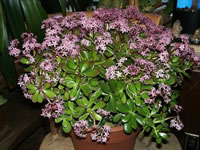
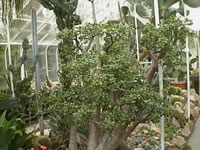
"Can you tell me what causes my jade plant to give off a sticky substance? It's on the leaves and all around it on the shelf where it is placed. Also, the leaves sometimes seem to be very fragile and fall off easily. I've heard that jade plants need lots of sun, but not much water, and that they're easy to propagate. But other than that I can't find any reference to sticky substances."
Hi Bonnie, I am not absolutely sure as to the cause of the sticky substance, especially since it is also on the shelf under the plant.
My guess would be that it is sap which the plant is producing in an attempt to protect itself from drying out.
While it is true that Jade plants (Crassula argentea) do not need as much water as a typical houseplant, it does require quite a bit more than most succulents and cacti. If the plant is to dry, the leaves will become thin and drop with the slightest touch. I would recommend that you increase the watering, both in frequency and quantity.
When the plant is actively growing, it should get a thorough watering every 7-14 days, depending on conditions such as room temperature and humidity and the size of the plant. Always let the soil become completely dry before you water again.
During the winter months when the plant growth slows, decrease the water quantity, and the plant can be left dry for a longer period of time (a month or longer)
After your first thorough watering I think that you will notice a very definite thickening of the leaves and stems. You should then be able to carefully wash the sticky sap from the leaves with a damp cloth.
Jade plants can be propagated with either leaves or stem cuttings.
Leaves which have fallen from the plant will often root by themselves, and produce a tiny plantlet. If you would like to start new plants, you can remove a couple healthy leaves and simply set them on top of a pot of fast draining potting soil, and after a week or so the leaf will begin to root itself. It may be a couple of months before you actually get a new plant.
If you want to start with a stem cutting, use a clean knife or razor blade and make your cut just below a stem joint. You must allow the cut to callous over (at least 3-4 days) before you insert the stem an inch or two into the moistened soil in which the plant will grow. This method will produce a larger plant much faster.
Keeping the soil temperature at about 80 degrees F. will speed the rooting process along considerably.
Jade plants can be pruned to whatever shape you desire.
The parts that have been removed can be rooted and used as new plants. Each cutting should be allowed to callous over (very important), for a day or two (longer if the cut surface is large) Plain, healthy leaves can be set with the cut slightly embedded into the soil surface. These will produce a miniature clone of the parent plant in about 2-3 months. Stem cuttings should be set about 1-2 inches deep, and will root and begin growing in a little as a month. Very little water should be given until the new roots have begun to form.