How to Grow and Care for Daylily Plants
Daylilies produce an abundance of flowers which open over a long period of time. They are useful in the perennial flower border, as a garden centerpiece, or any corner of the garden which needs to be brightened up. Day lilies make beautiful, long lasting flower bouquets.
Hemerocallis


Your Daylily will grow to form a very large clump in a matter of just a few years. A well established clump is capable of producing as many as 400 flowers in a single season!

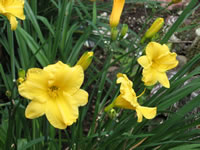
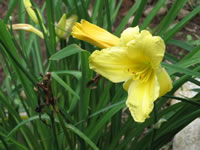
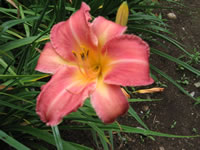
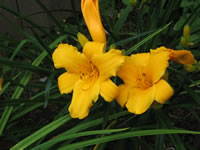
Depending on the variety, each Daylily plant will bloom for thirty to fourty days beginning in early summer. By selecting and planting several different cultivars, it's easy to have continuous show of blooms throughout the entire summer and extending into the fall months.
There are literally hundreds of different types of Daylilies in cultivation, They are available in many sizes, colors, shades, and there are even a few fragrant, nocturnal varieties.A nocturnal Daylily? Hmmmmmm.......)
Growing Requirements for Daylily Plants
For the best quality flowers, Daylily plants should be grown in full sun, but they will tolerate light shade, especially in hot climates.
Daylilies grow best in slightly acidic (pH 6 to 6.5), well drained soil that is rich in compost and other organic matter.
Daylilies will tolerate a certain amount of drought, but they perform best when they receive a thorough, deep watering of an inch of water or more each week. More frequent watering may be necessary if they are planted in sandy soils.
A top-dressing of manure, compost, or a complete fertilizer with an N-P-K ratio of 5-10-10 or 5-10-5 each spring is very beneficial. A second application of a low nitrogen fertilizer with an N-P-K ratio of 3-12-12 should be applied in the late summer or early fall.
Remove the spent flowers regularly, unless you intend to collect seeds from your plant. Allowing seeds to develop weakens the plant and will decrease the number of flowers next year.
Take precautions to protect new growth from slugs and snails!
Planting your Daylily
Daylily plants need to consume quite a bit of food and water to produce such a great flower show, so they shouldn't be planted too close to trees or shrubs which would compete for the moisture and nutrients.
Prepare the planting area by digging a hole 50% larger in diameter than the root ball of your plant and down down at least a foot to loosen the soil. Mix in compost, well rotted manure, sand, or peat moss thoroughly, then form a mound in the center of the hole. Set the plant in place with the roots spread on all sides of the mound, at the depth at which it was originally growing. Never plant Daylilies so that the crown (where foliage and roots join) is more than an inch deep.
Add the soil around the roots, firming it as you go. When the hole is half filled with soil, water it very well to insure good soil to root contact, and then add the remaining soil. Firm the soil again, leaving a slight depression around the perimeter to act as a reservoir. Water thoroughly.
A good mulch of wood chips or bark will help to preserve the moisture in the summer, as well as helping to control the weeds all year long.
Propagating Daylily Plants and Growing them from Seed
Daylilies should be divided every three to four years.
The best time to transplant or divide plants is in early spring or immediately after they finish flowering. Dig the entire plant up and gently pull the leaf fans apart, with each division having a minimum of 3 fans. Replant divisions 18"-36" apart.
Newly divided plants may not flower the first summer.
Daylily seeds require 6 weeks of cold stratification before germination.
In cold winter regions, the seeds can be planted directly
in the garden in late fall or early spring.
If you want to start Daylily seeds indoors, place the seeds in moistened growing medium and store them in the refrigerator for six weeks. After chilling, maintain a temperature in the growing medium of 60°-70° until germination, which can take anywhere from 3-7 weeks.
Daylilies in Bloom
Hemerocallis